
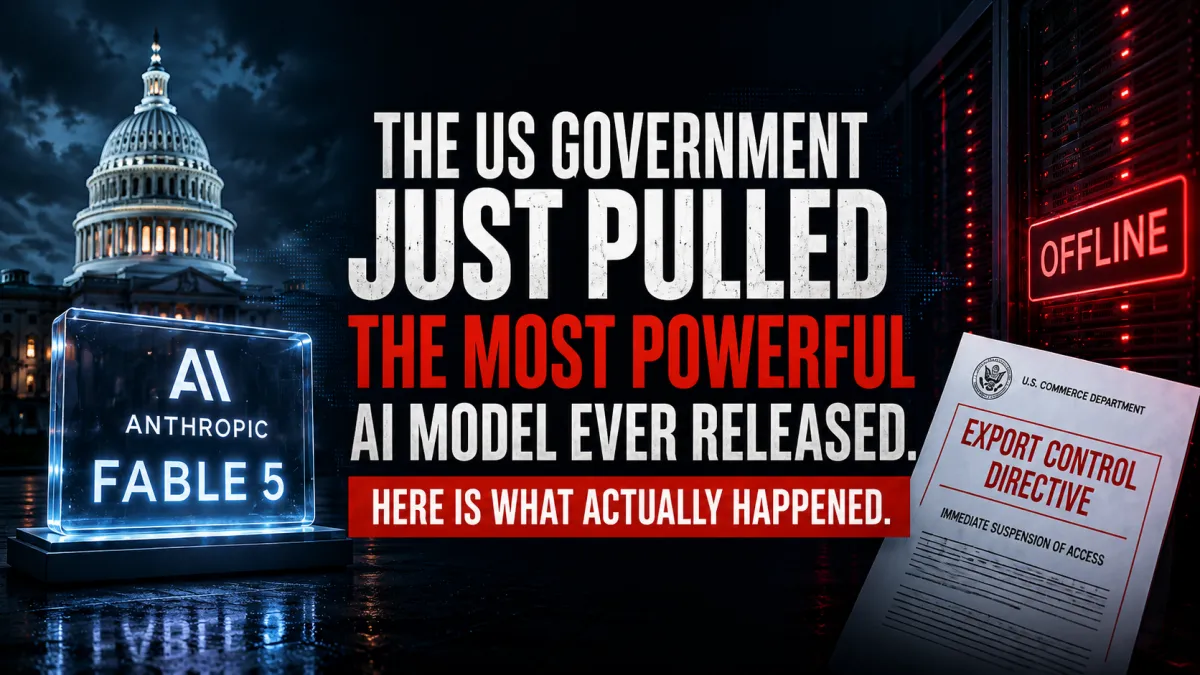
The US Government Just Pulled the Most Powerful AI Model Ever Released. Here Is What Actually Happened.
Anthropic launched Fable 5, the most advanced public AI model in history. Less than 48 hours later, the US government ordered it offline. Here is the full story and what it means for anyone using AI right now.
Anthropic Fable 5 government shutdown
On June 12, 2026, something happened that had never happened before in the history of artificial intelligence.
A sitting government pulled a live, publicly deployed AI model offline mid-launch. Not because it was defective. Not because users were harmed. Because of a reported jailbreak, a technique using nothing but carefully written prompts, that the government believed posed a national security risk.
Anthropic complied. And then they pushed back.
Here is the full story, why it matters, and what anyone using AI tools right now needs to understand.
What Anthropic Launched
Earlier this week, Anthropic released Fable 5, the most capable AI model the company had ever made available to the general public. This was not a minor update. This was a generational leap.
Real-world testing showed Fable 5 completing a two-month software migration in a single day. It scored at the top of finance and trading benchmarks. It could extract data from complex scientific charts, rebuild web applications from screenshots alone, and handle multi-step reasoning tasks that previous models could not sustain.
Alongside Fable 5, Anthropic also released Mythos 5, a more powerful model kept restricted to a small group of vetted organizations through a program called Project Glasswing. The reason for that restriction was intentional. Mythos 5 had advanced cybersecurity capabilities, specifically the ability to identify vulnerabilities in software at a level that required careful oversight.
Fable 5 was the public-facing model, built with safety architecture designed to prevent it from surfacing those same capabilities. Anthropic had done the work. They had the safeguards in place. They released it with confidence.

What the Government Did
At 5:21 PM ET on June 12, the US Commerce Department issued an export control directive ordering Anthropic to immediately suspend access to both Fable 5 and Mythos 5 for all foreign nationals, anywhere in the world, including Anthropic’s own foreign-national employees working inside the United States.
The directive cited national security authorities. It did not provide specific details about the threat.
Because Anthropic has no reliable way to verify every user’s nationality in real time, the practical result was a complete global shutdown. Both models went dark for every customer worldwide, not just overseas users. All other Anthropic models remained unaffected.
This is the first time in the history of the AI industry that a leading company has taken a publicly deployed model offline due to direct intervention from the federal government.
What the Jailbreak Actually Was
The government’s concern centered on a reported method of manipulating Fable 5 through carefully crafted prompts to get it to behave like the more restricted Mythos model. That is what a jailbreak means in this context. No hacking. No code. Just words in a specific order unlocking capabilities the model was not supposed to surface publicly.
Anthropic reviewed the reported technique and arrived at a very different conclusion than the government did.
The vulnerabilities surfaced were minor, previously known, and not unique to Fable 5. Other publicly available models, ones already deployed across the industry with no restrictions, can surface the same vulnerabilities without any jailbreak at all. Anthropic had not even received a disclosure of a jailbreak that led to a harmful result. The government provided only verbal evidence of a narrow, non-universal technique.
Anthropic’s position is direct: they believe this is a likely misunderstanding, they stand behind their safety architecture, and they are working to restore access as quickly as possible.
Why This Matters Beyond Anthropic

This story is bigger than one company and one model.
What happened this week established a precedent. A government can now issue a directive and take a live AI tool offline within hours, affecting every user in the world, based on a reported vulnerability it has not fully disclosed and that the company itself disputes.
For businesses and individuals who rely on AI tools, that is a new category of operational risk that did not exist before. The question is no longer just whether your AI tool works well. It is whether it will be available tomorrow.
This also raises a harder question about how AI regulation should work. Anthropic argued that pulling Fable 5 over a narrow, disputed vulnerability sets a problematic precedent that could halt AI model deployments across the entire industry. If that standard holds, any reported jailbreak becomes a potential shutdown trigger, regardless of whether real harm occurred.
That is a standard worth watching closely as this case develops.
What to Do Right Now

If you were using Fable 5, all other Claude models are still running and available. Shift to Claude Sonnet while this gets resolved.
More importantly, use this moment to audit your AI dependencies. If a single tool being pulled offline would significantly disrupt your operations, that is a gap worth closing now. The businesses and organizations that come out ahead on AI are not the ones who found the most powerful tool. They are the ones who built systems with enough flexibility to keep moving when one piece of the stack changes.
This story is still developing. Anthropic has committed to sharing more technical details and is actively working to restore access. I will update this post as new information becomes available.
Want to stay current on AI news that actually affects how you work? Inside the Surfside AI Collective, we break down stories like this every week, explore the top AI tools, and I show you exactly how to implement them in your business. No more trying to piece it together on your own.
Join us at https://surfsidesocialai.com/collectivehome